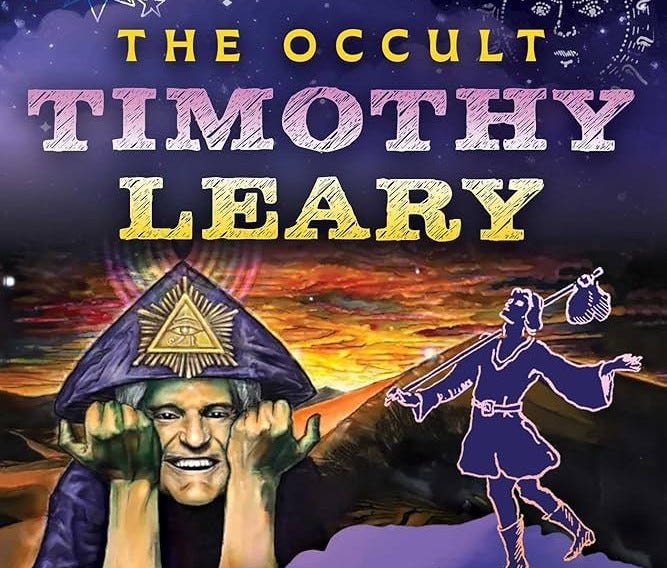
Timothy Leary and the Occult
Interview with author Joseph Flatley
We are delighted to feature this interview with author Joseph L. Flatley, whose new book The Occult Timothy Leary: The Tarot, Magical States and Post-Terrestrial Evolution is out now. It features a Foreword by R.U. Sirius
The British occultist Aleister Crowley (1875-1947) had a big influence on various countercultures and music scenes in the latter half of the twentieth century—not least on Timothy Leary who even claimed to be a kind of reincarnation of him at one point. In what ways did Crowley influence Leary?
When Leary and his colleagues at Harvard began studying psychedelics, they realized there was very little relevant academic literature out there. So they looked to the past — east and west — for people who had explored the same territory. Leary immediately recognized Crowley as one of those predecessors.
The overlap shows up in a few places. One is the idea of “Will” — Crowley’s notion that consciousness can be directed, engineered, intensified. Leary translates that into neurological language. Another is the use of symbolic systems — Crowley with the tarot and qabalah, Leary with his circuits and later the tarot overlay. And then there’s the persona. Crowley understood that the magician is also a kind of media figure, which is something Leary grasped instinctively.
The reincarnation line isn’t exactly a joke, but it is Leary’s playful way of placing himself in the Crowley lineage.
Recapitulating Leary’s biography in The Occult Timothy Leary works very well in describing the development of his Eight Circuit Brain model. What is its significance in Leary’s exploration of states of consciousness generally? And do you think he was above all a theoretician?
The eight-circuit model is Leary’s attempt to map consciousness in a way that accounts for both ordinary psychology and extreme states — psychedelics, meditation, ceremonial magic, all of it. It’s a framework that lets you locate experiences that would otherwise feel random or ineffable. What’s important is that it’s layered. The lower circuits handle survival, emotion, social behavior. The higher circuits open into things people historically called mystical — ego dissolution, time distortion, genetic memory, that kind of thing. He put all of that on one continuum.
Leary was very well educated and understood science, but his project wasn’t scientific — even if it used the language of science. It was pseudoscience, and I mean that in the best possible way.
After the psychedelic sixties, Leary became increasingly enamoured with questions of space migration, extended life and intelligence. How did these interests shape his understanding of the post-terrestrial brain circuits of consciousness? And do you think his off-world thinking was at odds with the emergent environmentalism of the time that focused on prioritizing looking after the pale blue dot of home?
Leary’s exploration of consciousness led him to ask big questions about evolution: where did consciousness come from? And where is it headed? Space migration and extended life aren’t sci-fi add-ons — they’re the logical endpoint of the higher circuits. If consciousness can detach from immediate survival concerns, then the next question is: where does it go?
The post-terrestrial circuits — what he sometimes calls the neurogenetic and neuroatomic levels — are about stepping outside the planet-bound frame entirely. Consciousness as something that can operate beyond Earth, beyond the lifespan of a single body.
That does put him at odds with a certain strain of environmentalism, which is focused on limits to growth. Leary is basically arguing for expansion — leave the planet, extend life, redesign the nervous system. But I don’t think he saw it as a contradiction. More like a division of labor. Some people stabilize the system; others try to break out of it.
A central part of your book examines Leary’s interpretation of the tarot using his eight circuit brain model. What role did the symbolism of the tarot play in Leary’s work generally, and how does it contribute to our understanding of his philosophy and practices?
The tarot gave Leary a symbolic language for his conception of evolution and allowed him to make the case that his ideas weren’t new at all. (Again, he’s illustrating that he’s part of a lineage.) The tarot isn’t decorative. It’s a tool for navigating the model.
Tarot is of course a practice. What practical applications does your book offer to readers, such as divination techniques and pathworking exercises based on Leary’s circuits of consciousness? And, it was surprising to read, that although he developed his own theories around tarot, he never developed his own deck. Were there ever any moves to do so? And which decks did he work with instead?
For Leary, the tarot stuff was really part of a larger project — an attempt to find correspondences between Western Hermetic symbols and practices, Leary’s neurological model, and, of all things, the periodic table of the elements. I’ve seen evidence that Leary did practice divination in the sixties, but that wasn’t his main concern.
My attempt to bring Leary’s ideas more fully into occult practice was an experiment: do Leary and Wilson’s proposed correspondences between classical occult symbolism and Leary’s theories on space migration, personality development, and stages of evolution actually hold water? I’m pleased to report that there’s something to it. I think the seasoned tarot reader can use the practices in the book (tarot spreads and Learian revisions of the cards) to compliment their existing practice.
How does your book address the broader context of Western occultism in the 20th century and its connections to Leary’s ideas? Particularly in regard to his friendship with Robert Anton Wilson and Discordianism?
The book treats Leary as part of a continuum rather than an outlier. He’s picking up threads from Crowley and earlier Hermetic traditions, as well as eastern spirituality, but he’s also embedded in a very specific 20th-century network.
His relationship with Robert Anton Wilson is key here. Wilson is doing something parallel — taking occult ideas and reframing them in terms of psychology, information theory, and play. Discordianism, with its emphasis on chaos, humor, and flexible belief, gives both of them a way to approach these systems without locking into dogma.
You see that tone in Leary as well. There’s a seriousness to the project, but also a refusal to treat any model as final. These are tools, not truths. The broader context is a shift in Western occultism — from secret societies and rigid hierarchies to something more open, experimental, and self-aware.


was just listening to a podcast about how Leary was probably a CIA asset, adjacent to MKULTRA. sounds like they finally broke him at Vacaville but he was on the payroll long before that. not quite the psychedelic saint people imagine.
Have a Butcher’s at today’s Divinations…
https://gorhall1.substack.com/p/illusion?r=4uede&utm_medium=ios