
Psychedelic Disclosures of Being
Review of Phenomenology of Psychedelic Experiences (2025) by Danny Forde

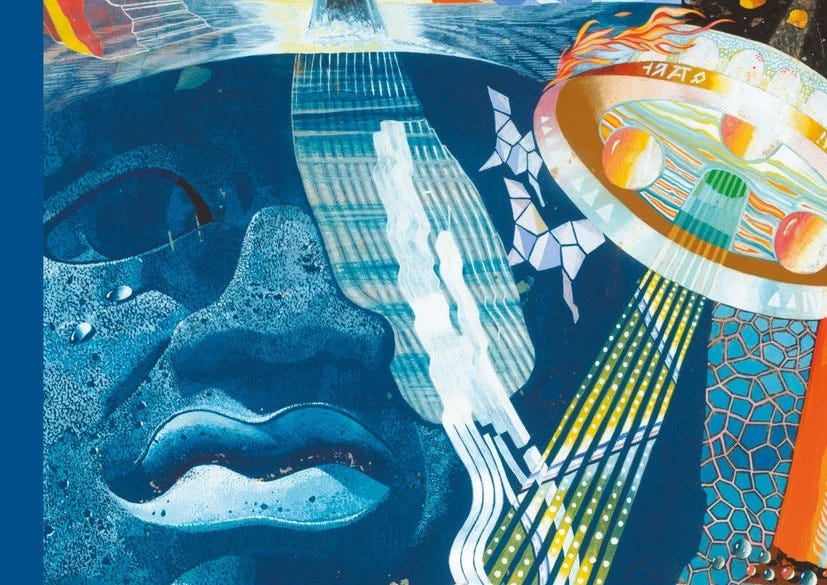
Phenomenology of Psychedelic Experiences (2025) by Danny Forde is a recent addition to the field of psychedelic philosophy. This field has been burgeoning within the academy for several years with the likes of Peter Sjöstedt-Hughes and Chris Letheby publishing notable contributions. Forde examines four claims around one’s sense of self, the revelatory aspect of one’s experience, the essential nature of reality, and the comprehension of archetypal phenomena as ‘essences’.
The author utilizes a framework derived from realist phenomenology, which he does in order to grasp the psychedelic experience and ‘analyse its modifications of the ordinary structures of conscious experience.’ By highlighting these modifications, and thus developing a structural analysis of consciousness during a psychedelic experience, Forde examines the implications in regard to several metaphysical questions that are derived from the aforementioned claims.
The book begins with a general introduction to dominant psychedelic discourses, focusing then on the ‘peak’ experience, or ‘Deep Integral Level of Self-Transcendence’, which, Forde argues, is relevant because the intensity is commensurate with its ‘long-term therapeutic efficacy’. Contrary to the pluralized title, therefore, it is a very specific mode of psychedelic experience which the author examines. Other therapeutic modes, such as the psycholytic, or indeed non-clinical ones such as the hedonistic or social are hardly considered.
With this in mind, Forde’s aim is to provide a novel phenomenological translation of the peak psychedelic experience as being commensurate with perennial and/or mystically described accounts. The structural analysis takes the form of ‘Subject—Mode—Object’, of which the author writes,
‘In any intentional act, a subject is directed towards an intentional object via an intentional mode. The subject is the conscious being who obtains the act. The intentional mode refers to the way in which the intentional object is given: linguistic thought, perception, sensations, emotions are all examples of intentional modes. The expression “intentional object” then refers to the entity which the intentional act is about.’
The argument that Forde develops in this analysis is described as ‘psychedelic realism’. Ultimately, this posits that aspects of consciousness, the self and the world-at-large can be disclosed as veridical through encounters with psychedelics. The fact of this revelation provides the therapeutic potential.
Chapter 2, focusing on the notion of ego-dissolution, tackles the question of ‘subject’ and aims at refuting the ‘neuroskeptical account’, which proposes that the ‘self’ does not exist, exemplified by Chris Letheby and others. Rather than seeing the self as a kind of cognitive ‘binding function’ for processing information, Forde turns to the work of Marie Guillot, and breaks down selfhood into a tripartite for-me-ness, me-ness, and mine-ness. In short, while ego-dissolution may do-away with the latter two aspects, for-me-this remains—i.e. this experience of losing ego happened to me.
Forde outlines how Letheby takes issue with this notion of for-me-this as a universalist principle. Using a passage by Michael Pollan (also used by Letheby) about a 5-MeO-DMT experience, he suggests that this aspect of self, for-me-this, is still present (contrary to Letheby). In this instance, the experience of terror (i.e., who experienced the terror?).
This is, however, one of the least well-developed arguments. Not only is one dealing with a text, bringing problems associated with culturally-contingent language, epistemologically-speaking it also raises questions centred on the role of memory—is the self, the for-me-this, a convention of writing or, indeed, the retroactive imposition of the binding principle? How might one begin to disentangle this using a phenomenological approach?
Chapter 3 deals with the ‘intentional mode’, emphasizing perception as the primary mode of phenomenal consciousness, arguing that psychedelics can reveal ‘mind-independent aspects of reality’. Again, Forde employs a tripartite schema, this time of hallucination: elementary, complex and metaphysical. He argues that it is the latter, metaphysical, that provide access to the veridical, i.e. mind-independent aspects of reality. This rests on one of the major claims made by psychedelic universalists; perennialism—encapsulated in, ‘If the doors of perception are cleansed…’, etc.
Chapter 4 tackles the ‘intentional objects’ one encounters during peak experiences, and how essences – the mind-independent properties of objects – are directly intuited. To give an example, Forde discusses having a vision of Odin, which he does in the context Jung and archetypes. As a mythopoetic experience, while the symbol of Odin does not really exist, there is eidetic intuition of an incarnated essence which does. In this regard, there exists the possibility of a revelatory experience of reality, or the Ground of Being. For Forde, therein lies the therapeutic aspect, in that it may ‘support a reorientation toward a more integrated and meaningful life.’
Finally, in Chapter 5, Forde argues that peak experiences are transformative in respect of both ‘what we know’ (epistemologically) and ‘who we are’ (personally). In short, affirming that such confrontations with the Ground of Being may confer lasting change on the experiencer. Positing that mystical apprehension is typically achieved via negative (concept elimination) and via positiva (affirmation), Forde argues that the peak psychedelic experience synthesizes the two, via psychedelica, and is thus a distinct route to knowledge.
Phenomenology of Psychedelic Experiences is a technical, academic book (published by Palgrave Macmillan) and is necessarily geared around the esoteric language of the academy. Nevertheless, it rewards further reading for a general audience. The book is thought-provoking, and the phenomenological-approach employed by Forde is a useful technique in breaking down the psychedelic peak experience as a mode of consciousness, and is well executed. It also begs further questions, or explorations, around other types of psychedelic experience—and this is always what one wants from an engaging book of philosophy.
Good stuff! I had a podcast with him: https://www.youtube.com/watch?v=NDcgzJxbU84
"obtains the act"
How does one obtain an act?
Is this philosospeak?
The often overlooked fact of psychedelic experience is that when you have certain unusual experiences you can neatly blame them on the drug, or on set and setting, and overlook their true source. Hoping I do not have to tell you what THAT is.