
Hashish Adventures in the Sixties
Review of Pipe Dreams and Smoke Screens (2025) by Richard Halford

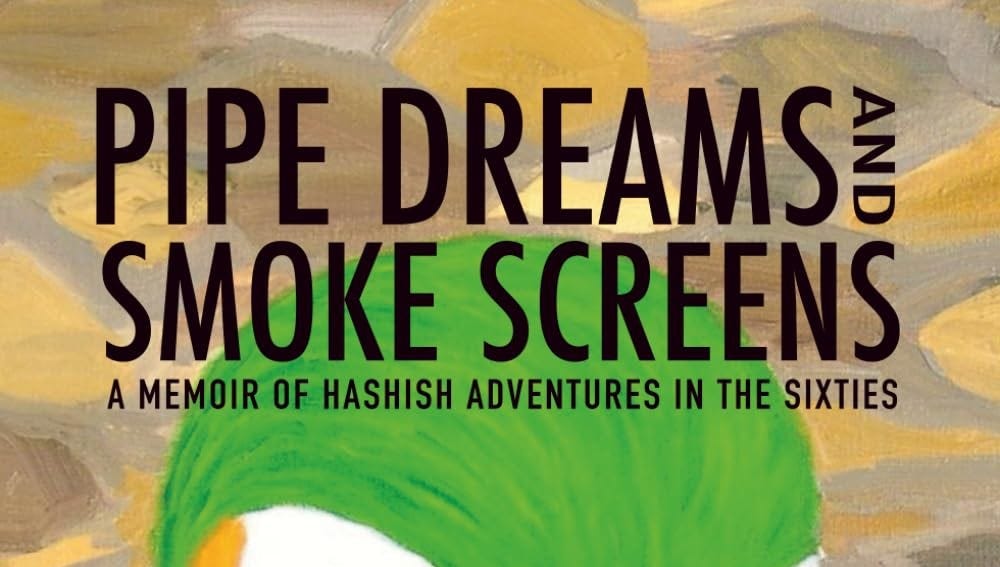
Drug-fueled (mis)adventures of youth are fertile ground for memoirs. Nowadays, it is the turn of those who grew up in the psychedelic-orientated mid-twentieth century who are reaching the age of mature reflection. Not that this has always been the case. Thomas de Quincey was 19 when he first started taking opium, but published his Confessions… (1821) well before his fortieth birthday. His famous tome launched a great deal of imitators, but there is a qualitative difference with many of today’s examples—for him, opium use was, for example, not straightforwardly countercultural.
The post-war period bequeathed us the figure of the ‘teenager’, who emerged at a nexus of influences, including the independence provided by cars, a separate cultural identity fostered by staying in education longer, catered for by music and fashion industries, and increasing economic affluence. While in some respects this was an American phenomenon, like much else, it was exported to Britain and Europe too, and for many of the same reasons. However, this 1950s culture morphed the following decade, as teenagers adopted a wider social and political identity, especially as university numbers swelled and individuals were exposed to the ideas of competing ideological elites.
Drug-taking, especially of cannabis and LSD, was a significant part of this counterculture—it was part of the rebellion against, not only one’s ‘straight’ parents, but also the political establishment and ‘straight’ society too. It was a symbol of transgression. Not in all quarters, I hasten to add, but in significant numbers. Therefore, one fascinating aspect of reading drug memoirs about the Sixties is understanding how the psychedelic experience permeated the counterculture’s worldview, both in respect of themselves, but also how they narrativized the world-at-large—the ‘us and them’.
Pipe Dreams and Smoke Screens: A Memoir of Hashish Adventures in the Sixties (2025) by Richard Halford epitomizes the countercultural, social and political worldview of that time, while also channeling some of the flâneur tradition of De Quinceyesque drug writing. Near the beginning, he writes, ‘And though I like to think that what follows all actually happened, there’s absolutely no guarantee that any of it did. I could be dreaming it all.’ An excellent reminder that a memoir, for all its historical context, should also be read and treated as literature—which is no less informative.
Born in 1945, Halford grew up with the great nuclear standoff of the Cold War looming overhead, and a Britain he describes as small, grey and claustrophobic. Then, shortly after the Cuban Missile Crisis in 1962, he decided to escape and head to Europe—specifically to Franco’s Spain, a country that was ‘a wounded victim of the obsession with an ideology that had gripped the twentieth century like a psychopathic strangler.’ He wound up living on the islands of Formentera and Ibiza which, having supported the losing side in the Civil War, had been especially punished by after Franco’s victory.
Quite cut off from the cultural changes rapidly spreading in other parts of the world, Formentera was at this time still populated by locals in traditional clothing, without many modern conveniences. Halford was part of a small wave of cosmopolitan newcomers who would eventually transform the island, and nearby Ibiza, over the following decades as tourism boomed. Then, there were full moon acid parties, and ‘We were trance dancing, chanting, singing, playing drums and flutes and all the rest of it.’ For the most part they were welcomed by the locals, ‘or at least tolerated us’.
Halford is quite scornful of the post-war tourist industry’s transformation of the Balearic Islands. Yet, this is the repeated story of ‘gentrification’. The early adopters may have enjoyed the freedom of lifestyle found in traditional, homogenous communities that were not their own, yet their very presence presages the changes that were about to happen. They were not only countering the culture of their home, but also that of the people they chose to live beside instead. And this is particularly true of drug-taking, especially on the Islands, situated, as they were, between North Africa and mainland Europe—a literal stopover between producers and consumers of hashish.
The Guardia Civil—Spain’s militarized national police force—operated mostly in rural areas during Franco’s reign, and became notorious for their heavy-handed tactics. They understandably take on the role of antagonists in Halford’s memoir, keen to police drug use and with a distaste for the long-haired, strangely clothed newcomers. There’s a very excellently written chapter in which two search Halford’s flat, in which he had stashed some hashish on a ledge in his chimney but had forgotten about some acid tabs in a more obvious place. Dodging the authorities was occupational.
Over the course of the 1960s, Halford makes repeated trips back and forth from Formentera to Morocco, during which time he also started making hashish himself, which he describes with great care and obvious love of the process, explaining how one produces the very best quality. Over the course of the book, descriptions of the drug experience are few, but there are two in particular—one with hash cookies bought in Marrakesh and another with Owsley’s famous White Lightening LSD—that are very well executed. The former, channeling the flâneur:
So I wandered like a character on an odyssey through my own myth, sitting for hours in front of drummers or dancers or mysterious diviners who worked with tarot cards and white doves, with the birds choosing the cards and thus the fate of the anxious supplicants.
In regard to writing, Halford has a particularly evocative style in regard to place. His descriptions of the Rif mountains, the Balearic Islands, Marrakesh and alike are excellent at transporting the reader into the local atmosphere. This skill also lends itself perfectly for the few trips he describes. The cast of characters come and go, with plenty of doses of hippie wisdom shared, but although they never feel fully fleshed out, this is perhaps the point. The culture was transitive and changeable. They, like wider culture, were quickly revolving. The world up close from the window of a moving train blurs.
Pipe Dreams and Smoke Screens is really a series of vignettes, bookended by one particular smuggling mission and the end of the 1960s. When Halford provides the context for the world-at-large it is well-executed, grounding the reader in time, but definitely confers a sometimes simplistic view of the historical changes that were going on—or had gone on in Britain and Europe. Nevertheless, Halford’s writing style is very engaging, and his experiences of that world – dreamed or otherwise – are very well told. Well worth the literary trip.