

We are pleased to share the next chapter of Tim Hardwick’s Gonzo Metaphysics series—delving into the pre-Socratics with a dose of LSD. The wonderful Ersatz have made a spellbinding piece of music to listen along with while you read:
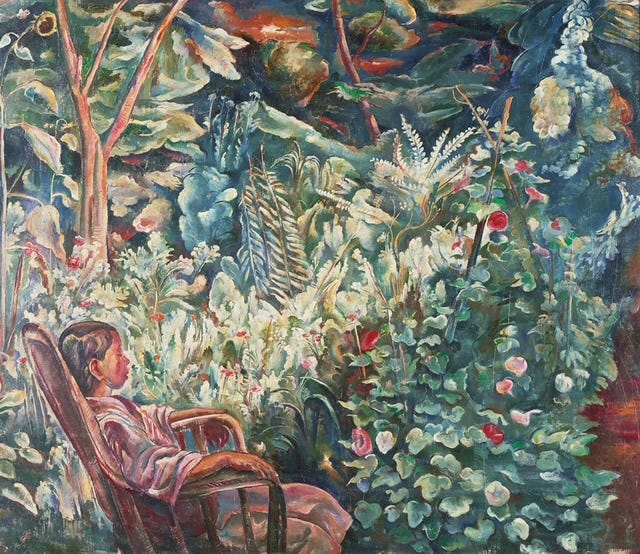
I slide into an old garden wicker chair and open a book about the pre-Socratics as two small LSD gel tabs gradually metamorphose into butterflies in the pit of my stomach. My friend and I have rented an idyllic cottage nestled in stunning Welsh countryside for this moment, and its beauty is positively distracting. Between the pages of the book, I’ve been admiring a row of orchids nestled in a border between a lawn and a pathway that extends from the patio, where I sit, to a broader parterre that frames a landscaped run of water continually breaking to crystal over a shallow rock face.
Tens of thousands of orchid species make up the ancient orchidaceae family, and no doubt several are dotted around this well-cultivated patch of land, but it is the distinctive bilateral symmetry of the bee orchid and its visual likeness to its nectar-loving namesake that stands out to me. The bee orchid is a perfect example of nature’s duplicitous conceit, as expressed in the ardent sexual trickery of its pollination technique. Its purple sepals crown the visual characteristics of the female insect, a seemingly infallible decoy blended within its folds. The raised labellum, bearing a pattern that resembles the abdomen of the female, is conspicuously enlarged into a landing pad, over which hang two sticky masses of pollen grain, ready to hitch a ride on the next unwitting mate. Each tender petal bends back like a come-on, evocatively moistened by coalescing crystals of dew, framing a fused pistil and stamen in a central rib that decorates the central column – the fulcrum of an erotic mandala, beckoning the insect in.
I try to see with the eyes of a male bee in the midst of this floral mimicry, a pulsing beacon of desire amid the garden’s avalanche of shifting colours. Every flower is unique, particular, each petal continually changing its ultra-violet iridescence depending on the insect’s angle of vision. As the fine grain of this image rapidly intensifies, I’m awestruck by nature’s variegated dimensions of being and its ability to redeploy instinct in ingenious ways. The bee carries out its pseudocopulation with the orchid in blissful ignorance, performing its vital function neither knowing nor caring to know what lies beyond the veil of the flower’s mesmerising illusion. Yet when the act is so symbiotic and innately gratifying – indeed an amorous end-in-itself – then naïveté, I suppose, is beside the point.
Bees do not deign to think. As for myself, I am twice removed from the insect’s Eden. Being self-conscious, I don’t just think. I think I think. I continually reflect upon my thinking by manipulating the same symbol systems that ground my ability to reason. I wonder how accurately this habit of reason reveals the ‘true’ state of affairs in the world, but this immediately strikes me as the wrong question, since it assumes from the outset that the world is reasonable to begin with. From a pragmatic point of view, our rational faculty registers patterns in experience and enables us to make long-term predictions that are of inestimable aid to our survival. But it also forces us all to confront our ultimate fate. For just as the classic syllogism concludes of Socrates, the foresight which reason grants us necessarily reveals to us our own mortality. Perhaps this is why, in the Phaedo, Plato’s character Socrates claims that those who genuinely follow a philosophy of wisdom ‘pursue the study of nothing else but dying and being dead’. For without wisdom we are unable to reconcile our mortal anxiety with the untroubled fluctuations of nature, which leads us to conclude that our entire perspective on life is somehow skewed.
This skew seems itself to be a symptom of reason’s refusal to accept that change might be fundamental rather than a complicated ruse overlaying a stable reality. The mind senses flux and immediately demands a hidden rationale, as if the world owed it a fixed footing. This impulse is not some contemporary human affliction, as the book in my lap reminds me. The pre-Socratic thinkers expressed the same anxious uncertainty in the face of nature’s effortless, self-moving harmony. At first they tried to steady it by naming some abiding principle beneath its surface. Their answers famously differed – water, air, a fiery cycle of decay and renewal. Despite the lack of consensus, most thinkers agreed that whatever composed its nature also governed its movement. It was self-animating, like the churning seas and the rushing wind, and imbued with an eternally alive and divine spirit. Only later did the problem harden into the question of knowledge in itself. Parmenides was the primary instigator who pushed the rationalist impulse to its limit, arguing that if reason discloses what is real, then reality itself must be one, static, and eternal, and the senses are fundamentally deceptive. Heraclitus, by contrast, located intelligent order within the flux itself. Yet between these opposed visions lay an unresolved tension: how could the mind reconcile the ceaseless change disclosed by the senses with the permanence that reason seemed to demand for anything to be truly knowable?
As I sit like another twined branch of this wicker chair, the words on the page acquire a curious vitality. The pre-Socratics are no longer interminably remote historical voices, but active companions in my unease, forming a collective struggle to synthesise what the world shows with what the mind demands. Parmenides’ icy vision of a perfectly static reality confronts Heraclitus’ perpetual fire, and I feel the two positions buffeting up against one another like opposing winds circling the garden. As this dynamic tension gathers, my mind sinks, almost involuntarily, into the memory of my first psychedelic encounter with Plato, whose genius was to synthesise the two thinkers’ views in a way that seemed to offer both a workable metaphysics and an ultimate theory of knowledge.
Indeed, the pages in my hand seem to open a corridor back into that earlier trip, as though the reading itself has become a soft incantation. But recalling Plato’s dualism – as it manifested in the resonating antechamber of a maiden psychedelic voyage – now seems to run roughshod over the philosopher’s ‘two-worlds’ theory. As I deliberated over its permutations during the onset of the experience, the actual forms of the things around me had grown more intensely and defiantly real – at once brilliant and definitive, as though their pared-down essences were driving to the fore of my awareness in an alchemical condensation of meaning. As the internal visions deepened, Plato’s participatory thesis gradually began to fray and unfurl, before completely collapsing under the weight of its own fractal logic. Plato did not simply claim that Forms allow us to see relationships of similarity or identity between things and then place them within a common category, like a mental concept is supposed to; he believed the Forms actually cause these relationships of similarity and identity, while having an entirely separate nature to them.
For Plato, Forms are never in things, which are always subject to decay. They exist in an eternal realm beyond the senses, but somehow cause things to be what they are, whether that’s trees, flowers, cats, or any other logically categorised species apprehended by the mind. The only reason humans have any inkling of Forms at all, he claimed, is because our immortal souls beheld them in a timeless Reality before we were born, an innate knowledge that we simply recollect.1 The body is essentially ignorant, its senses the source of all error. And yet – how the interaction is supposed to occur between these two disparate worlds, the Form and the appearance, the intelligible and the sensible, the soul and the body, was something Plato could never fully explain.
In light of the philosopher’s failure to establish a relation of formal causality between the Form and its appearance, a shocking deformation of the things around me that day took place. The more things strayed from their typical frames of reference, the more exaggerated became their unclassifiable uniqueness and stubborn particularity. My unquestioned belief that things are pre-given, readymade objects just waiting to be labelled and categorised by the mind was stripped away like a veil by an act of perceptual violence that amounted to a chaotic escape from form. Reasonable as it seemed prior to the trip, my lifelong assumption was that the concepts we use to identify things in the world correspond with things that are already out there, just waiting to be discovered. The idea chair and the word ‘chair’ simply pick out similar chair-like objects in a purely passive way, and these concepts are organised into a hierarchy of mental categories (furniture).
But in the perceptual upheaval that had ensued, I realised this could not be right at all. To say what something is already seems to presuppose some knowledge of what makes it the kind of thing it is. To say one knows a thing implies that there is already something which gives rise to the thing that one has knowledge of. To understand the idea chair, for example, requires abstracting from the particularities of all the different chairs one has encountered in the world. But in order to do that, one needs to know in advance how to identify the essential features that characterise all chairs – one must already have the concept chair in mind – otherwise how could the essential features of a chair be isolated in the first place? Like Plato, I was unable to explain the causal relationship between mental ideas and the material world. In a circuitous route through ancient philosophy to extant reality, the drug had exposed my complete ignorance regarding the fundamental problem of conceptual knowledge. I was trapped inside a vicious circle in which generalising implied abstraction and vice versa, and there was no clear way out.
Later that day, as the world began to settle into its typical quiescence, as my body and the objects around it assumed their familiar hard boundaries and uniform colouring and my old centre of narrative gravity slowly coiled up in the mottled light of a new dawn, I struggled to square a deeply felt sense of renewal with this newfound deep-seated intellectual confusion. In the 1950s, psychedelic drugs were given to psychiatric patients in the belief that they facilitated subjective insight into the unconscious causes of neuroses and thereby granted self-autonomy and the motivation to effect lasting personality change. The contents of my own unconscious self-revealing, by contrast, went far beyond the realm of psychodynamics. The baseline wavelength of my waking consciousness had been denatured so thoroughly as to precipitate a fundamental change in the very structure of experience, in a manner which nothing could have prepared me for. Admittedly I had feared for my sanity during parts of the trip, and yet the lingering impression coming back to my everyday existence was one of psychological rejuvenation, like a recovering patient regaining vigour after a long convalescence, or a former addict coming to lucidity following careful withdrawal and rehabilitation.
An expansive sense of calm had emerged from deep within me. A hidden weight lifted, and everything sparkled with a sense of frontier-like discovery. As I observed specks of golden dust floating through the first shafts of light coming through the curtains, my thoughts continually orbited the crystallising memory of the last few hours like the celebrated site of a newfound precious ore. Throughout it I had been subconsciously aware of a tacit refusal to accept what was happening, yet this denial was merely a pre-amble for what was to come and did nothing to postpone the moment when my worldview turned completely in upon itself. The things of the external world had taken flight of their usual staid and limpid execution, as had the inner world of my private thoughts, and I was no longer the genesis nor the architect of the ideas that materialised in my mind – for materialise they did. At the peak of the experience, thought itself took on a glowing, etheric substantiality, and I can only describe what happened afterwards as a total inversion of the geometry of ordinary experience. Consciousness as such no longer felt as though it was located inside me, somewhere behind my eyes and between my ears. Rather, it was the other way around. The sensation of having a face and head and body simply hovered in a space of expanded awareness, which in the hours immediately after, I hesitated to call my own.
As far as I could fathom the night’s events, I had been thrust headlong into a direct encounter with my own metaphysics, or what Aristotle called ‘first philosophy’ – only this was more like first-person philosophy in terms of its total immediacy and unflinching absolute givenness. I had been forced to acknowledge and disown my lazy assumption that philosophy was a ‘navel-gazing preoccupation’ that had little significance outside the halls of stuffy faculty departments. For the first time, I knew what it meant to live and breathe an inherited metaphysics that says we are wholly material creatures, and that mind arises from the neural activity of the brain as an evolutionary byproduct of adaptive fitness. (This default-mode humanism, I later learned, is an aspect of metaphysical naturalism, a physicalist image of the world I’d previously seen no reason to doubt, let alone acknowledge.) I’d also been blind to the fact that the very same paradigm conveniently sweeps under the rug its most implicit and intractable problem: how to explain the relation between the mental and the physical. Given that I am the product of a typical Western upbringing and a twentieth century educational system that considers cogito, ergo sum to be the paragon and endpoint of philosophical inquiry, this fundamental conundrum had never before taken root in my thinking. The dualistic conception of reality instilled in me suggested that whatever consciousness ‘is’ must be vaguely synonymous with the voice inside my head that continually narrates experience. This sense of self with which I identify is the locus of consciousness, a focal point from which I look out upon the world and make sense of it, but also an experience apparently entirely generated by the grey matter encased within my skull. Of course, despite inheriting this materialist outlook, I still acted as if the colour, weight, texture, and resistance of objects were part and parcel of an existence independent of my consciousness. Far from being states of mind, I implicitly believed that things and their qualities existed in and of themselves, regardless of whether I or anyone else was around to observe them. I was simply never taught to question such deep-seated contradictions. My cultural conditioning had seen to that.
Looking back on the experience, everything about it inclined me to accept that I basically knew nothing – a perspective which, while profoundly liberating, came with its own seemingly intractable problems. This questioning and uncertainty also wound up to be a profound moral dilemma, since the flaw in Plato’s theory of Forms wasn’t just a failure to explain sense perception and conceptual knowledge. It was also an ethical failure due to its inability to adequately furnish terms of intellectual inquiry such as ‘goodness’ and ‘justice’ with their proper definitions. No wonder Socrates and Plato had tried so hard to discover the true objects of reference for the meaning of such words. It had never before occurred to me that knowing what the right thing to do in any situation, or what the ‘right thing’ even means, depends on my metaphysics – on my implicit beliefs about the structure of the universe and my place within it.
In the wake of my psychedelic baptism, on the morning after and in the days that followed, I struggled to reconcile these insights with my life as I had lived it. Every decision to act – even simple choices like what clothes to wear in the morning and what to eat for breakfast – I continually second-guessed. All I could conclude was that some aspect of my awareness remained in that freestanding space in which everything I thought I knew to be true and real was completely upended. It was at least a month before I came to realise that there was only one way forward in such a surreal situation, a single direction in which to aim: I would have to read philosophy, then take the drug again.
And so, here I am, in a Welsh cottage garden, surrounded by bee orchids and acid butterflies.
This was why it was so important to Plato to be able say what a thing is by defining its Form.

Thought-provoking. Exploring such questions too...
Here's some philosophy I posted just yesterday:
Are You Sure?
Can we reason our way to certainty? To "Truth"? ...A philosophical question
Peter Webster
Sep 18, 2024
Cross-posted by KOSMOS
"Psychedelics, Reason, Truth, and the possibility of arriving at the latter by judicious use of the former."
- salience
https://peterwebster.substack.com/cp/211855604