When Humphry Osmond coined ‘psychedelic’, he famously did so in order to find a word that would infer the myriad multidisciplinary nature of the kinds of altered states of consciousness that certain drugs create in people. In an age dominated by psychotherapeutic and psychological language, Osmond wanted philosophy, the arts, literature and alike to be integral to the conversation. In this, it seems to me, he was very successful and ‘psychedelic’ has traversed the medical, cultural and social spheres in the intervening decades with fluid ease.
Attempts to simply demarcate psychedelic are bound to fail, or at the very least will restrict the utility of the word, consigning it to more rarefied, technical discussion. In an age today where specialization demands focus on detail and the specific contours of one’s own field, it is very easy to fall into the trap of missing the wood for the trees. It is both useful and insightful, therefore, to occasionally take a step back and survey the landscape—to place the details in a larger context and, more importantly, to take philosophical stock of precisely what that context is.
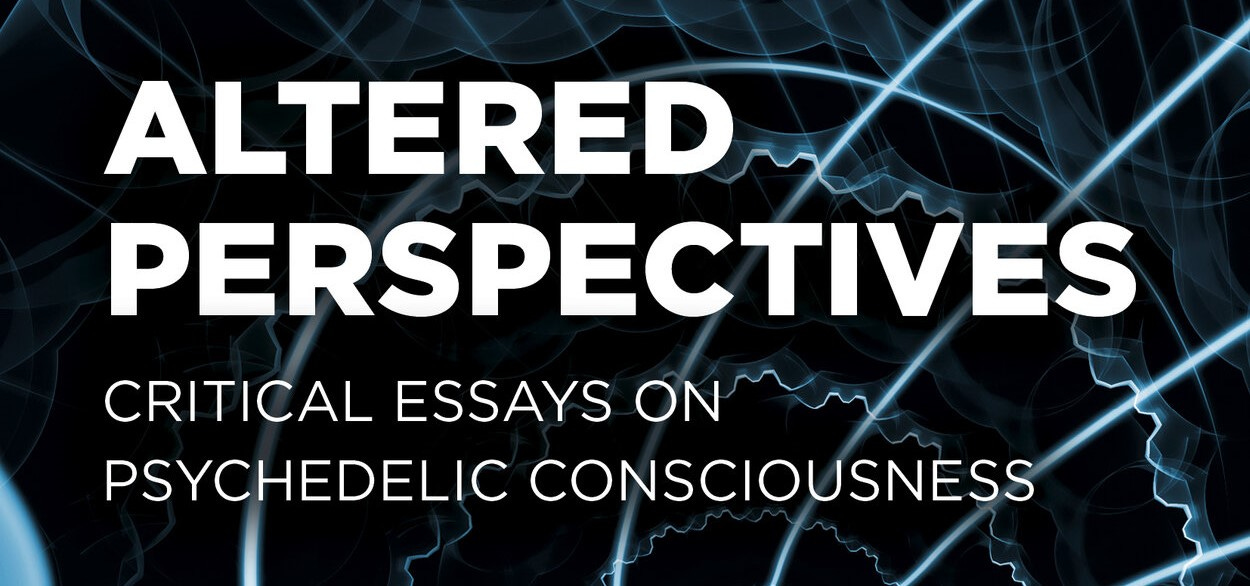
In Altered Perspectives: Critical Essays on Psychedelic Consciousness (2024), writer Sam Woolfe does precisely that. For many years, Woolfe has been writing essays on a variety of aspects in psychedelic studies, and this collection brings them beautifully together. In many respects, ‘psychedelic consciousness’ is the context, not only in the narrow theory of mind context but, more importantly, as the philosophical core of psychedelia; the transformer through which intellectual and creative powers manifest psychedelically.
The topical breadth of Woolfe’s analyses is impressive: ‘The psychedelic phenomena I attempt to interpret through these various lenses include seeing the self as an illusion, noetic experience (feelings of profound insight), alien abduction-type experiences, the sublime (fear mixed with wonder), visions of alien symbols/writing, meetings with jester entities, the feeling of receiving messages from spirits, déjà vu, and existential joy.’ It is also, in the finest exploratory traditions, a collection that does not aim at definitive answers, but instead a thorough, intellectually grounded discussion.
Woolfe’s essays often surprise in their comparative analyses yet always prove fruitful. In his opening essay, ‘Mescaline Revelations’, he uses his own experiences with the classic psychedelic to explore the ‘illusory self’ using the ideas of Scottish empiricist philosopher David Hume and certain tenets of Buddhism—a connection less obscure than one may at first assume. ‘I have since tried to think of this mescaline experience in terms of the principle of non-attachment, which does not mean a lack interest in positive or negative experiences or giving up those experiences; it means not allowing these experiences to own you.’ There remains, as such, a practical grounding in these essays.
Philosophically-minded, Woolfe’s real strength is in developing is argumentation. He is clear-minded enough to make certain theoretical tangles accessible, yet never allows them to be dumbed down. An excellent example of this is in ‘A Profound Feeling of Familiarity: Bergson, Déjà Vu, and DMT’. French philosopher Henri Bergson can be quite a tricky thinker to get your head around, let alone on DMT, yet Woolfe neatly explores his theories around memory to argue that the DMT experience has the power to reveal the mechanics of memory and perception.
Sometimes the psychedelic field can feel like a large therapeutic monocrop, yet in truth it’s a patchwork of varied fields connected by hidden footpaths and byways in wooded boundaries and winding country roads. In this respect, Altered Perspectives is a field guide of sorts, one which records Woolfe’s amble through this countryside, providing learned insight into not only the flora and fauna he has encountered, but the very philosophical structures of the psychedelic field system itself. All ten essays are a valuable contribution to psychedelia, and I highly recommend a read.