How I Met Legendary Acid Chemist Richard Kemp
(and stole his walnut!)
Since the early 2000s, when I began writing about the history of British psychedelic culture, I have been fascinated by the Operation Julie/Microdot Gang saga. My first dose of acid, in 1972, was two green microdots which almost certainly emanated from one of chemist Richard Kemp’s laboratories. They blew my mind and set me on a course down many weird paths and destinations, although few quite as strange as the day I finally met Kemp himself.
During my years of research, I have been fortunate to meet many people involved in the Microdot Gang, including distributor Alston ‘Smiles’ Hughes (whose biography I wrote and who sadly died in August 2025), Andy Munro (the other MG chemist), Leaf Fielding (now dead), Russ Spenceley, Eric Burden and Henry Todd (I sold him a book once but didn’t realise who he was until later—doh!). Yet the main chemist, the ‘goose that laid the golden egg’, Richard Kemp, proved elusive.
In the 2000s, I did manage to track him down, now living in Spain, and working in, of all professions, property development! I sent him a copy of the first edition of Albion Dreaming: A Popular History of LSD in Britain, and he responded briefly but cordially, saying he liked the book, but didn’t want to answer any of my many questions. He also urged me not to believe everything I read about him. Disappointing, but fair enough I suppose.
Between 2008-2025 several film and documentary makers approached me with plans for an Operation Julie documentary, each absolutely convinced, in that shiny certain way media people exude, they could get Kemp to speak exclusively to them. Of course, it never happened, as I knew would be the case. And despite Christine Bott’s post-Microdot Gang friend Catherine Hayes visiting him in 2023, no one has to date interviewed Richard Kemp in any depth.
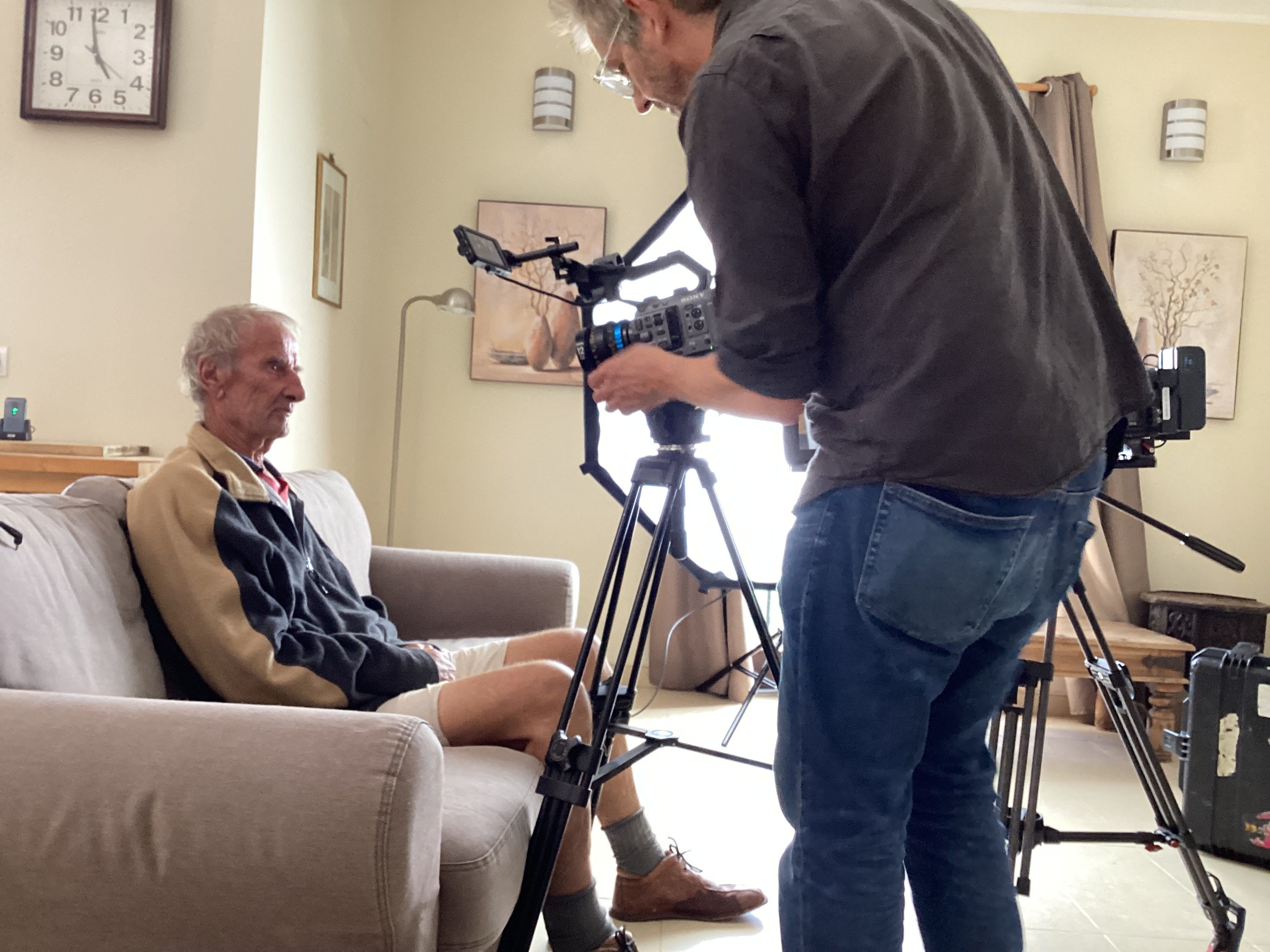
Things change though. For the past few years, I’ve been working with Indefinite Films who have serious aspirations to produce a drama series and possibly a documentary about the Microdot Gang/Operation Julie events. Bruce Goodison, the Director, had briefly visited Kemp in early 2025, and conducted a sample interview, arranging to return later in the year. And guess what? I was asked to go along to provide back-up knowledge and ask some questions.
So, on September 27, after a frenetic evening of trying to pack everything I thought I needed into a bag which also fulfilled draconian cabin bag measurements (I’m a nightmare when it comes to getting ready for trips at the best of times) and an extra pipe before bed, I found myself being driven through a glorious dawn, headed for Manchester Airport.
Once in Alicante airport, I had several hours to wait for the film crew to arrive so settled down to people watch. Bruce and vision/sound man Timney’s plane was delayed, and they didn’t land until about 23.30, after which we sorted out a hire car and drove the hour or so to the town where we had booked an apartment.
That night the gods provided the most dramatic electrical storm I have ever witnessed, and the rain was still lashing it down when I woke. Spain still smelled of summer despite the deluge and as we weren’t due at Kemp’s until lunchtime we went to Bolo’s Bar for some breakfast. This was a weird experience. Bolo’s was obviously the local tradespeople’s bar and it was full of practitioners of all trades (tool belts a go-go- think Spanish Village People!), eating God knows what and washing it down with lashings of alcohol—at 9am! Then trotting off to work on buildings, possibly at height and with power tools. You don’t get that in north Wales!
In due course we drove through the mountain foothills to Kemp’s place, part of a hillside complex of villas, where he’s lived for 20 years or so and which wouldn’t have looked out of place in a film like Scarface or the Godfather; sun drenched with mountain vistas on all sides.
Richard came out into the drive to meet us, and in possibly one of the most surreal moments of my life I found myself shaking hands with and introducing myself to one of the planet’s most legendary LSD chemists. ‘Hi, I’m Andy, you might remember we had some correspondence in around 2007?’ Kemp’s expression suggested he had no recollection and this vagueness, selective or not, was amplified when Bruce introduced himself and reminded Richard they had met much earlier this year. Once again, no acknowledgement from Kemp.
We were invited to sit down on a terrace and as Bruce kindly made tea and sandwiches, I made small talk with Richard. But just how do you make small talk with a legendary acid chemist? I gave him a copy of the new edition of Albion Dreaming and spluttered out random questions…
In 2019, at the Glastonbury Festival, I’d heard rumours that, post-prison, Kemp had taken up making acid again for a while, this time in Goa. So, Richard, ‘did you stop taking acid after you were released from prison?’
‘Oh God no, I was making it’ In Goa? ‘No, near Madras’, although, ‘I haven’t taken it for years and years’, No further information was offered or asked, for obvious reasons.
An only child from a working-class background, Richard had a normal childhood in and around Bedford before drifting, almost by accident, into studying chemistry in his mid-teens. He ‘can’t remember’ what initially led him down that path but eventually he went to Liverpool University (via being expelled from St Andrew’s) and the tedium of studying for a degree and then a PhD, which he never attained.
Kemp’s life changed dramatically in Liverpool through Nick Green, a friend of David Solomon’s daughters. ‘Nick approached me and that was what got me involved [in making acid] in the first place’. Kemp soon met Solomon through Green and regards him as ‘the instigator of the whole bloody thing.’
At the time, Solomon’s house at |Grantchester Meadows (as per the Pink Floyd song), near Cambridge, was a well known gathering place for local hippies, either trying to get off with one of Solomon’s daughters or just wanting to hang out and get high with a famous author (Solomon had already written two books by this time, LSD the Consciousness Expanding Drug (1964) and The Marijuana Papers (1966).)
Solomon had asked Green if he could make THC which Green agreed to but although he had studied organic chemistry with Richard Kemp, attaining a 2.1, he had transferred his studies to Oceanography and as such no longer had access to chemistry labs at Liverpool University. But Kemp did. The existing MG literature suggests the fist batch of acid was made in Green’s parents’ house. Was it?
‘It might possibly have been, or it might have been in the university labs’, Richard told me, adding, ‘oh yes, it was easy to make’ using one of the many syntheses found in chemistry literature. The suggestion that LSD was ‘easy’ to make immediately begged the question, ‘Do you have to be a chemist to make LSD, or could you just essentially be a cook, following a recipe?’ Richard laughed, ‘well, yes is the answer to both those questions. It’s like saying do you have to be Graham Hill to drive a racing car, and I could drive a racing car so…’
On one visit to Solomon’s house Kemp was introduced to the enigmatic Ron Stark; ‘a somewhat mysterious character who claimed to have worked for the CIA, the FBI, this that and the other; he was a bizarre character and also a revolting looking man but a very clever man.’ Did Richard think that Stark was working for the CIA or similar agencies?
‘I think he probably was, he was a renegade who saw the light [via acid] and changed the direction of his life as so many of us did’. I suspected Kemp could have told me much more about Stark, but I thought it best just to let him take the conversation in whichever direction he wished. Richard then revealed his first psychedelic experience wasn’t with LSD but with mescaline, given to him, bizarrely, by the scientist Francis Crick. Crick was a user of psychedelics in the late 1960s but this played no part in his co-discovery of the DNA double helix in 1953 despite the urban legend to that effect.
Solomon, Stark and Paul Arnabaldi (another enigmatic character about who little is known) arranged for Kemp to move to Paris, where Stark already had a lab, to make LSD for which there was an increasing worldwide demand. In the few months he worked in Stark’s lab, ‘We made lots of LSD which was packaged up and sent to America where it was sold at an extremely healthy profit’.
It was also while working for Stark that Kemp discovered the ‘wrinkle’. ‘Well, I don’t know where that term came from, [but it] speeded up LSD production and guaranteed a purer yield.’ What was it that you did? Richard gave a short, snort of a laugh and said, ‘I can’t remember’.
Kemp disavows the term ‘wrinkle’ now, saying his discovery was just happenstance; he left partly made LSD in the fridge overnight and in the morning it had crystallised. I know little about chemistry, but Richard knows lots. He was at pains to stress that Lysergic Acid was no use unless and until it is tartrated, otherwise it is ‘unstable, deliquescent and hard to work with’ and ‘that was one way of getting the crystals out. If you’re an organic chemist the secret to getting a good product is to crystalise it because once you’ve crystalised something, just by definition, crystals are 100% pure and you don’t get the crystals unless you go about it in a particular way.’
At some point during his tenure with Stark in Paris, Kemp created what was to become the infamous ‘brown acid’ distributed at the 1969 Woodstock festival. There was no hint of the hippy dippy trippy in Kemp’s description of acid manufacture. It was, essentially, just a job, ‘once I gave them the finished product that was the end of it, all I had to do was wait and get paid, that’s the most important thing’.
Following a brief period in Paris, Stark moved his lab to Orleans but there was trouble in paradise. Stark, now he had Kemp’s services, no longer wanted Solomon and Arnabaldi’s involvement and Kemp claims Stark gave Arnabaldi a massive overdose of LSD, ‘a dose he never really recovered from’, in order to discourage him from further involvement. Matters worsened when Solomon and Arnabaldi argued they weren’t being paid enough by Stark, despite them having given him, ‘their chemist’, and this, among other bones of contention, led things to ‘get quite nasty’, resulting in Kemp returning to Britain.
Once back Henry Todd and Brian Cuthberston set up the basis of what would be ‘the Microdot Gang’ (a term Kemp hates, ‘there was no gang’). Kemp wasn’t at all keen on discussing Todd or Cuthbertson in the interview, other than noting that it was Cuthbertson who ‘invented’ the microdot and the means of its manufacture. ‘I’d leave them out of it as much as possible, especially Henry as he’s the sort of bloke who’s capable of getting quite shirty’. That may be, but Henry won’t be getting ‘shirty’ with anyone in the foreseeable future as he died on 2 November 2025.
Kemp made LSD in several locations. ‘We moved around a lot, [it’s] important to keep moving’ for security reasons. There were labs in London, Bath and Chesterfield, but the main lab was situated in north central Wales at Plas Lysin, for which Paul |Arnabaldi was technically the owner but was paid for by Kemp. Richard remembered little of Arnabaldi other than that he served with the Marines in the Pacific theatre during WWII and had latterly become friends with David Solomon, almost certainly through their connection with Leary at Millbrook. Arnabaldi also provided cover for Kemp’s first major run of LSD at Plas Lysin; Kemp in the basement mixing up the medicine whilst Arnabaldi did building work and fended off potentially nosy neighbours.
Did Richard, whilst manufacturing LSD, have any, for want of a better word ‘rituals’ or music he listened to, lucky underpants etc. as some acid chemists did (for example Casey Hardison had a particular piece of music he listened to during the manufacturing process)? This question elicited an emphatic ‘No, you’ve got to concentrate, you can’t fuck about with music, you’ve got to concentrate on doing what you’re doing.’
Kemp frequently displayed frustration with many lines of our questioning, either because he didn’t want to comment for whatever reason or because he just ‘couldn’t remember’. He seemed highly unwilling to talk about some of the key people in his life. For instance, he refused point blank to talk about the Microdot Gang mastermind, Henry Todd, almost to the point of him seeming scared of him! Similarly, but perhaps for different reasons, he would not discuss his relationship with Christine Bott, other than to re-iterate she played no part in the creation or distribution of the LSD he made. Essentially, he didn’t want to discuss his emotional life or personal relationships and at times said, ‘this is getting tedious’. There was almost a sense that we perhaps weren’t asking the right questions, or maybe he genuinely just couldn’t now recall the minutiae of what happened over 50 years ago.
As we know, the Microdot Gang Empire came tumbling down on the morning of Saturday 26 March 1977 when dawn raids across England and Wales resulted in the arrests of Kemp, Bott, and the majority of the Microdot Gang. At his trial in 1978 Kemp was sentenced to thirteen years in prison, which he described as ‘a bit like being at public school in many ways’. For a while, he and Christine Bott remained a couple and Kemp was allowed monthly visits to see her, ‘Chris was in HMP Durham with [serial killer] Myra Hindley with whom she was the best of friends.’
As we approached the end of our second day of interviewing, we asked Richard to sum up what acid meant to him. This resulted in more frustration at the pinch point where memory meets expectation, ‘so what’s acid like then Richard?’
‘You don’t know till you’ve tried it and once you’ve tried it, you’re never the same again, it’s as simple as that really. The effect you get depends on the amount you take, it’s not compulsory to blow your head off.’ Quite. I think we all know what he meant whether through accident or design. What did Richard like to do when he was tripping? ‘Listen to music, have sex’. He wasn’t very forthcoming and couldn’t even come up with a favourite tripping album other than to say, ‘I don’t like jazz’. So, what was the point of it all?
‘Money, lots of it and the buzz of turning on the world principally,’ he said. ‘To turn on the world, to shake things up a little, to cause change.’ I think it’s safe to say that Kemp’s acid certainly did that for possibly hundreds of thousands, possibly millions, of people and is certainly the reason I began writing about British LSD culture. And the rewards? ‘I got paid for what I did and I was quite happy. I handed over my lovely crystals, and they were duly tabbed up by whosoever and….’ The rest, as they say, is history.
In the final minutes of our interview, I asked Richard if he would be interested in allowing me to write his ‘authorised’ biography, but no, a short, ‘I think I’ll leave that until after my demise.’ If his memory is as poor as he claims there may not be much more to discover, although I very much doubt that.
Richard is almost 83 now and though he appears not to be suffering from any major health problems he isn’t as agile as he once was and walks with a pronounced limp caused by a 1960s motorcycle injury to his foot. Otherwise, and probably due to the amount of physical work he is conducting on his villa, he appears remarkably fit.
Before we left for the drive to the airport Richard took Bruce and Timney on an extensive tour of the property whilst I lounged in the sun. En route from the kitchen to the terrace, I noticed a small brown object on the floor. Hoping it was a lump of hash I bent to pick it up and it turned out to be a nutmeg in its shell. Guess what reader, I stole it as a ‘souvenir’ of my meeting with Richard Kemp and just hope it wasn’t intended as an ingredient for his evening meal that day!
Musing on the experience now, three months after the event, I am still slightly fan-boy shell shocked. Did I really meet one of history’s most significant LSD chemists or was it all just a pipe dream. Then I look at Richard Kemp’s nutmeg, and realise yes, I did, it was all true, I’d achieved a life goal of meeting and interviewing Richard Kemp!
More information gleaned from these interviews will form part of my forthcoming book about British acid labs 1965-2025, Clandestine Chemistry, which I hope will be published by Psychedelic Press in 2027.
Eternal thanks to Indefinite Films for making the above happen!


Appreciate your tenacity & devotion to the research, Andy. His keeping some of that history to himself lives in service to the mystery of the very molecule he synthesized. To make Global amounts places one onto a narrow thread guide. Great article.
Place that Nutmeg upon your hearth.
Thank you very, very, VERY much!! As a person who has literally spent the majority of my waking hours for the past 60 years researching (and being a part of) the history of underground LSD manufacture and distribution, I found this to be fascinating!!!